


M5792
£18,500
Description
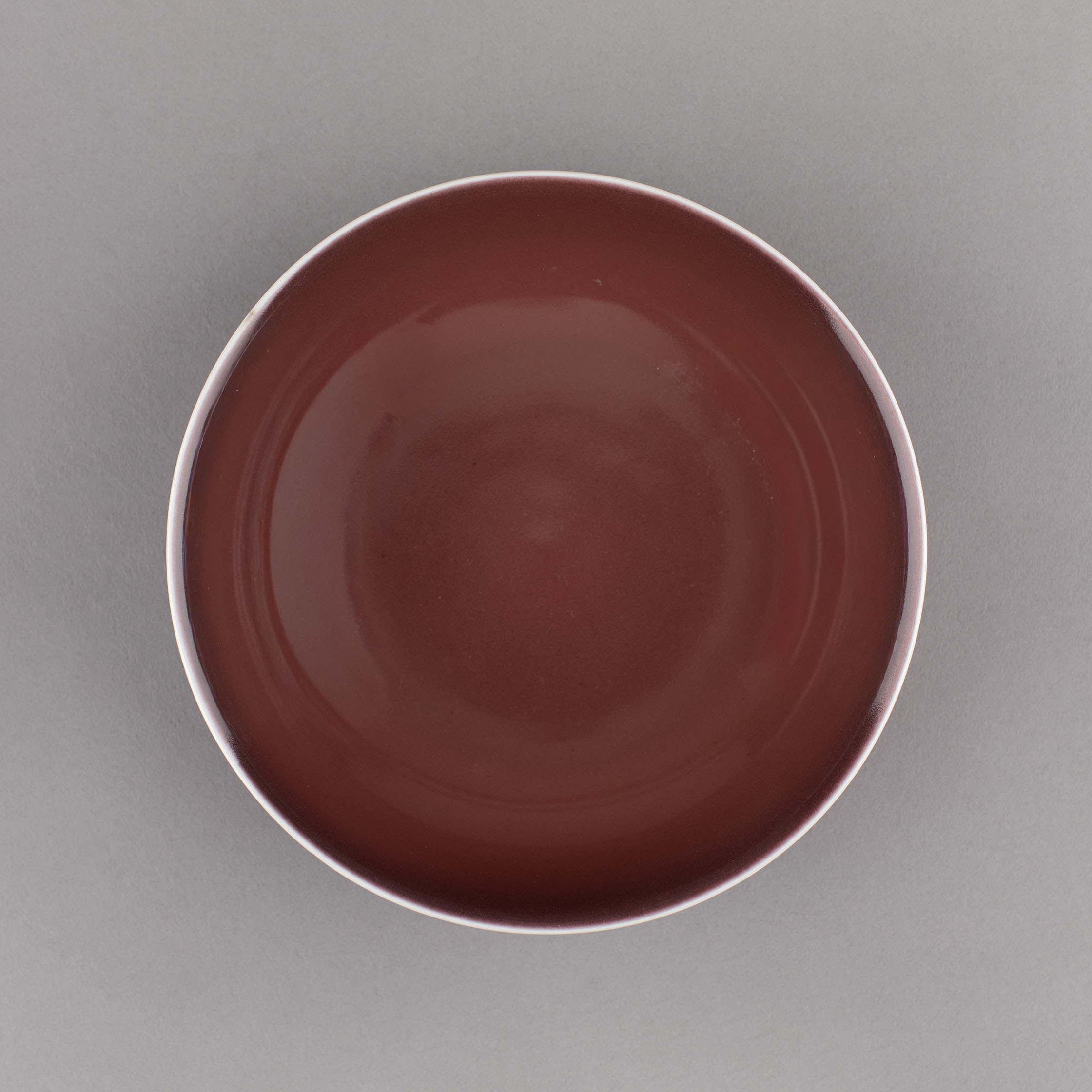
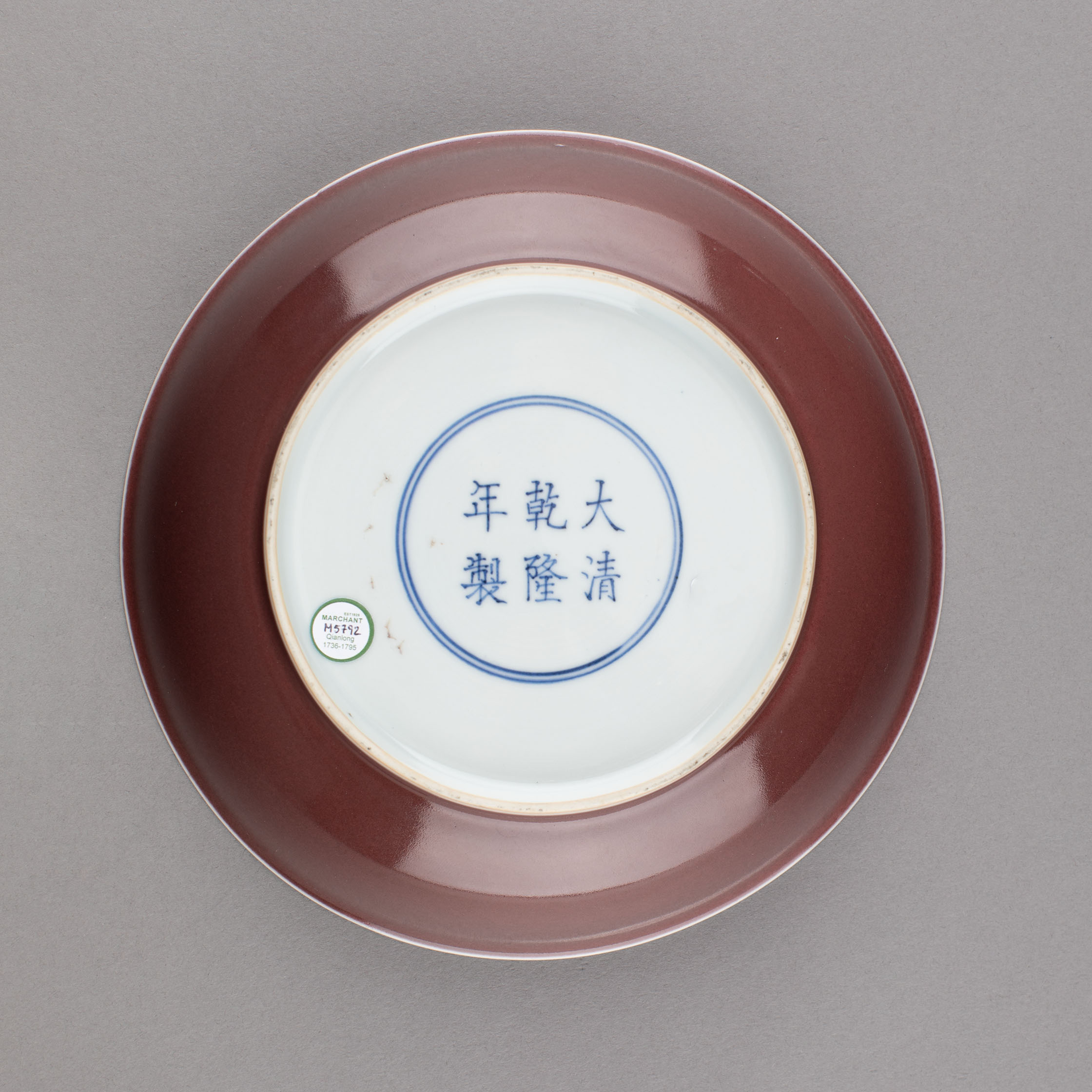
Chinese imperial porcelain copper-red glazed saucer dish, thinly potted with gently flared lipped rim, covered overall in a rich and even sang-de-boeuf glaze beneath the white-glazed rim.
The base with a six-character mark of Qianlong, within a double ring in underglaze blue and of the period.
Qianlong, 1736-1795
6 15/16 inches, 17.6 cm diameter.
Condition
Hair crack and tiny rim nibble.
Provenance & Additional Information
- From the collection of Gustaf Oscar Wallenberg (1865-1937) and thence by descent.
Wallenberg was a famous Swedish businessman, a diplomat and active politician. He was the son of André Oscar Wallenberg, founder of Stockholms Enskilda Bank, today known as SEB. After a career in the Swedish navy, he was very active in the trans-Oceanic shipping industry. He was an envoy to Tokyo between 1907 and 1918, and during this time he travelled to Beijing to amend the Treaty of Canton and to establish diplomatic relations between Sweden and the Qing court. His entire oriental art collection was believed to have been purchased during these years, with documents preserved at the Ӧstasiatiska Museum, Stockholm.
He was the grandfather of Raoul Gustaf Wallenberg (1912-1945), the architect, businessman and diplomat, designated by Yad Vashem, Jerusalem, as one of the ‘righteous among nations’ as well as having many monuments and streets named after him, in honour of him saving thousands of Jews in German-occupied Hungary during World War Two. The family art collection was split between the Stockholm museum and family members.
- This dish is part of a rare group with an unusual six-character mark of Qianlong, rather than the more typical sea lmark, indicating that this is perhaps the first production of Qianlong imperial reign mark pieces, circa 1735/6, as stylistically the characters, particularly the nian character, closely resemble those written in the Yongzheng period.
- A similar dish with a white-glazed rim, bearing the more typical seal mark of Qianlong, is illustrated by Liu Liong-yu in Ch’ing Official and Popular Wares, p. 205; another in the Percival David Foundation of Chinese Art, British Museum, is illustrated by Stacey Pierson in A Collector’s Vision: Ceramics for the Qianlong Emperor, no. 89, p. 102.
Similar Items

R1407
Chinese imperial porcelain doucai tripod censer, san zu lu, painted on the body with the Eight Buddhist Emblems, bajixiang, each ribbon tied amongst scrolling lotus and peony flowerheads on branches with scrolls and leaves, beneath a yellow ground ruyi-head band, between two curved openwork handles with open-winged iron-red bats and aubergine bats at the terminals, the flat sides with keyfret, with a lotus flowerhead interlinked branch on the neck above a green-washed band, the relief galleried rim with iron-red keyfret, all on three cabriole feet with flowerheads and branches linked by ruyi-heads, above further keyfret at the foot.
The rim with a six-character sealmark of Qianlong written in a line within a double rectangle in underglaze blue and of the period, 1736-1795.
11 ⅛ inches, 28.3 cm total height.

26 - M4491/2
Pair of Chinese imperial porcelain lavender-glazed altar vessels and covers, dou, each modelled after an archaic bronze with moulded and carved archaic designs, the upright body with ribs and bands all on a splayed, ribbed foot, the cover with a design of scrolls, fretwork and two registers of stylised waves beneath a double-rope twist openwork finial, covered overall including the interior and underside in a luminous, rich and even lavender glaze, all the rims dressed in brown in veneration of the archaic prototype.
The interior of the cover and the underside of the base of each with a six-character sealmark of Qianlong and of the period, 1736-1795.
9 ¾ inches, 24.8 cm and 9 ⅞ inches, 25.1 cm high.
8 - M5279
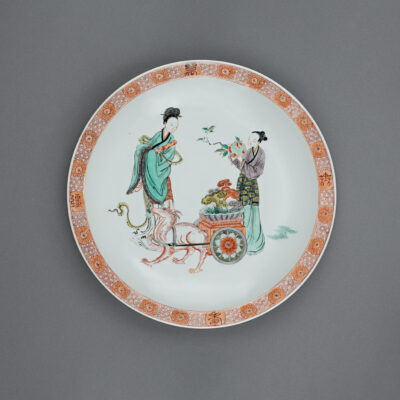
Chinese imperial porcelain famille verte birthday dish, pan, with flat everted lipped rim, painted in the centre with Lady Magu standing holding a scroll looking back at her attendant with a large peach, beside a tethered mythical deer drawing a wheeled square jardinière supporting a fruiting lingzhi group, encircled by twenty iron-red flowerheads on a hexagonal diaper ground between four-character medallions, wan shou wu jiang, “endless longevity”.
The base with a six-character mark of Kangxi within a double ring in underglaze blue and of the period, 1662-1722.
9 ⅞ inches, 25.2 cm diameter.
