


M5763
Description
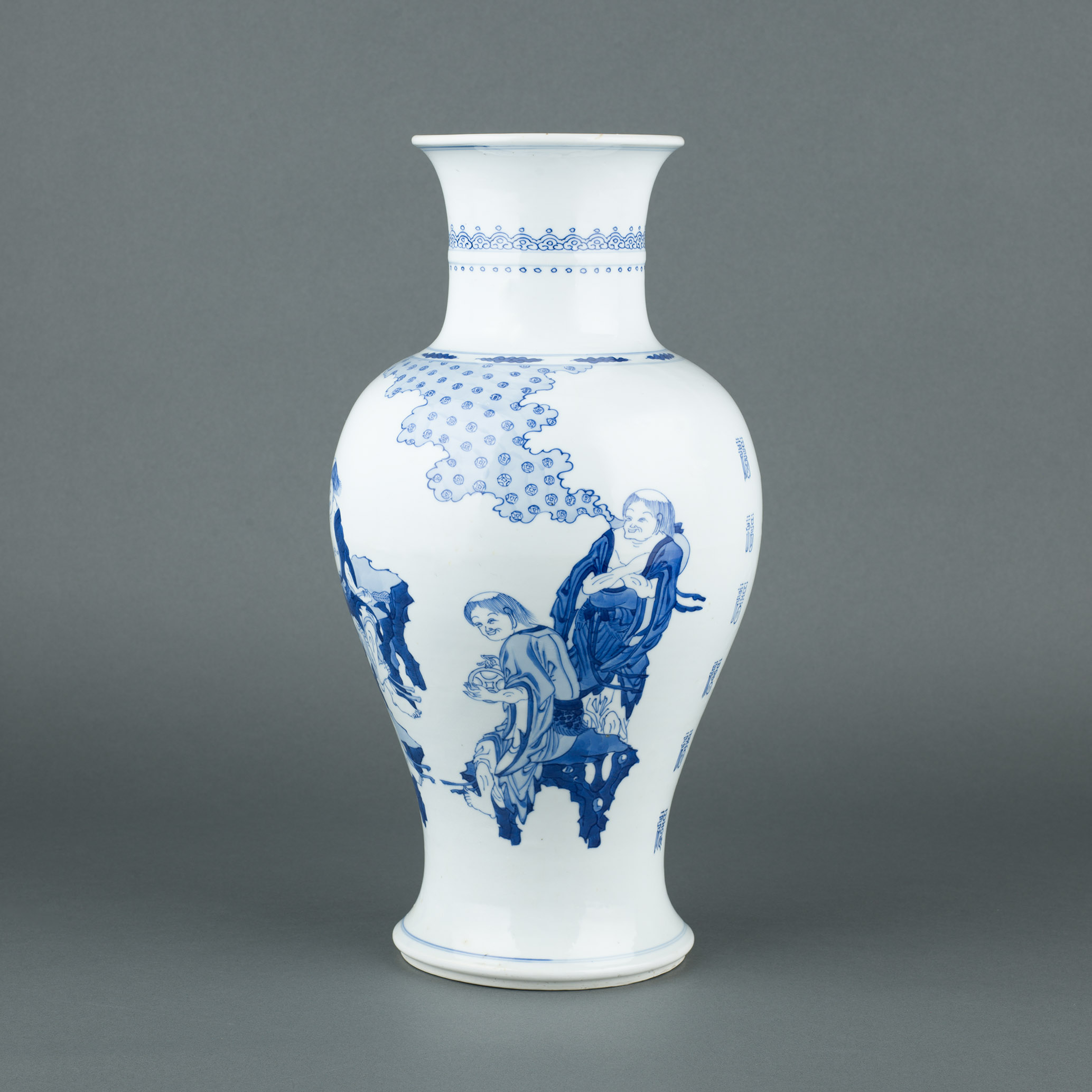
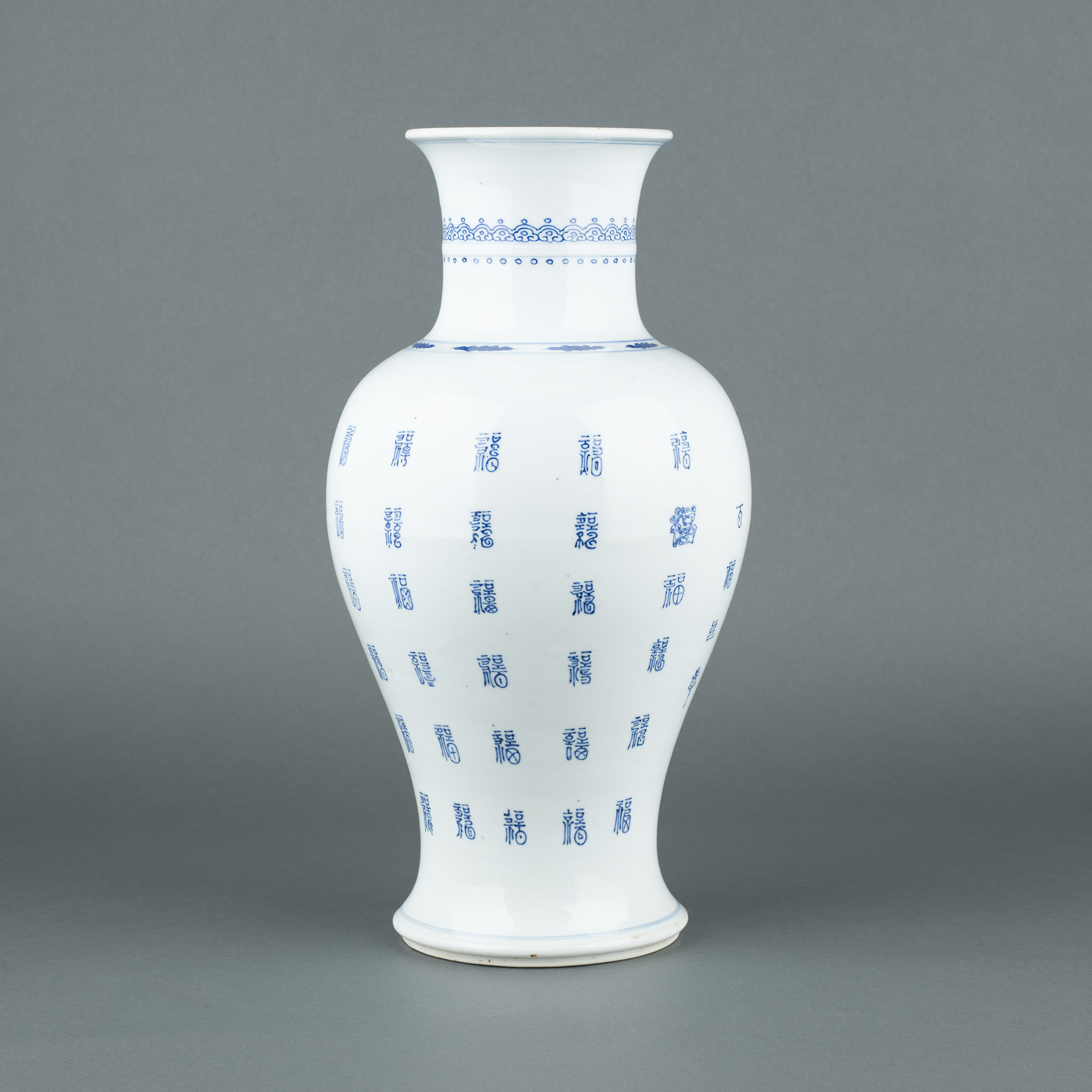
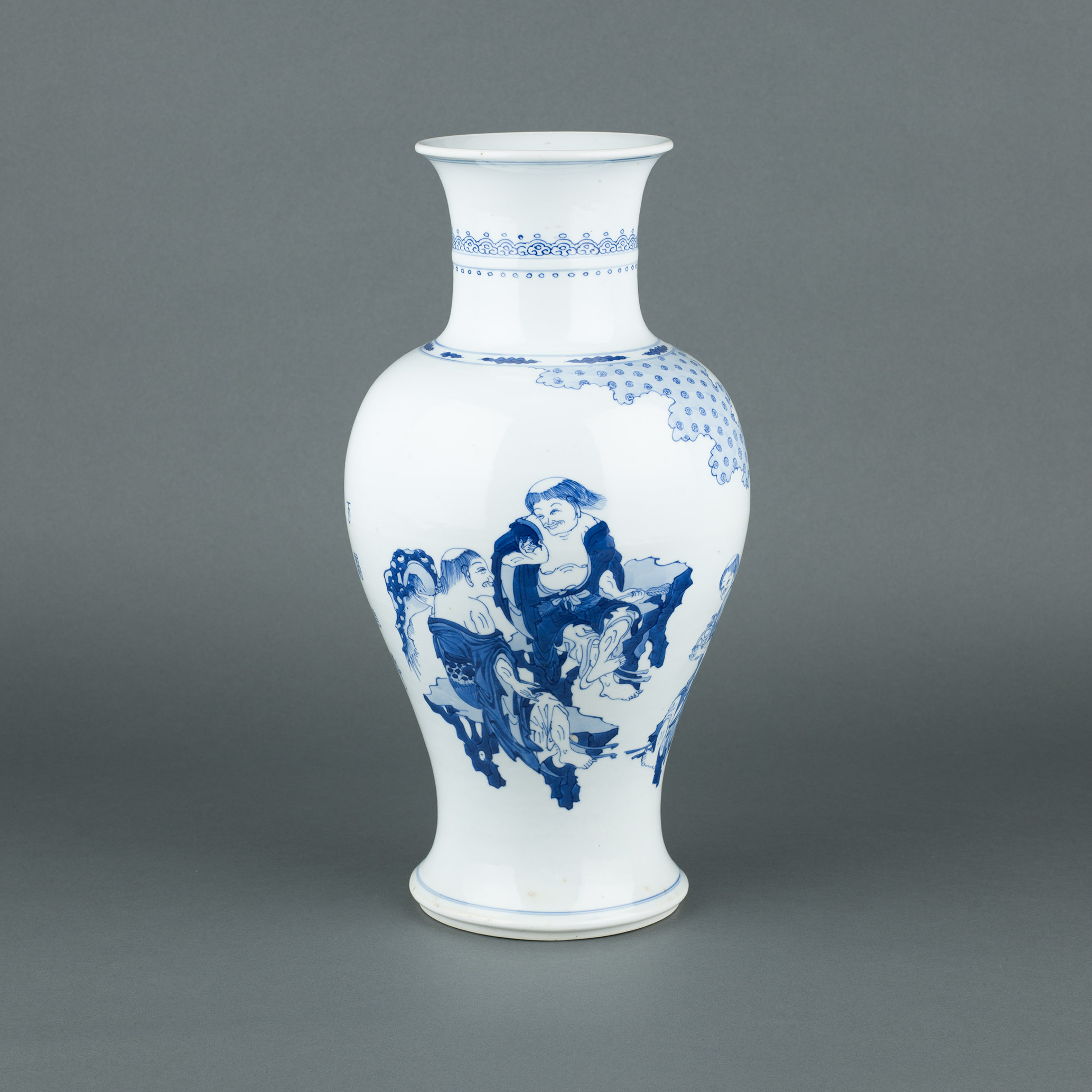
Chinese porcelain blue and white baluster vase of guanyin zun form, with cylindrical, flared, ribbed neck and gently splayed foot, painted with Liu Hai, seated on a naturalistic rockwork table with his three-legged toad, beside Zhongli Quan, seated on another naturalistic rockwork table and holding his fan, with the Hehe Erxian brothers nearby, both smiling, one standing with a gourd on his back, from which emanates a cloud of coins, while his brother sits on a rockwork table holding a large coin in both hands, all above two underglaze blue lines and beneath a band of ruyi clouds at the shoulder, the ribbed neck with a band of ruyi heads and pearls, the reverse with a four-character mark bai fu cheng xiang, “hundreds of blessings, longevity and happiness”, alongside thirty differently written fu characters, “happiness”.
The base with an underglaze blue double ring.
Kangxi, 1662-1722
16 7/8 inches, 43 cm high
Condition
Available on request.
Provenance & Additional Information
- Sold by Christie’s South Kensington in their auction of Oriental Ceramics and Works of Art, 8th May 1997, lot 262.
- From the collection of Lip Keong Tai.
- Included by Stuart Marchant in Marchant – One Hundred Years, Volume II: 2001-2025, London, 2025, p. 538, image no. 2071, p. 531.
- A famille verte rouleau vase of this subject from the collection of J. M. Hu was sold by Sotheby’s New York in their auction of Important Chinese Ceramics from the J. M. Hu Family Collection, 4th July 1985, lot 54, and again by Sotheby’s New York in their auction of Important Chinese Art, 11th September 2019, lot 905. The pair to this rouleau was sold by Christie’s London in their auction of Fine Chinese Ceramics, Jades and Works of Art, 8th & 9th December 1986, lot 431, and again by Christie’s New York in their auction of A Park Avenue Collection, 17th April 2024, lot 43; a blue and white pear-shaped vase of this subject, Yongzheng mark and period, was sold by Sotheby’s Hong Kong in their auction of* Fine Chinese Ceramics and Works of Art*, 2nd May 2000, lot 672.
- Liu Hai is a popular Chinese Immortal associated with wealth and is well-known for having a “pet” three-legged toad that lives in a river and is tempted out by a string of coins. Once out of the water, Liu Hai would clamber on its back and be transported anywhere in the world. He was originally a Tang dynasty minister of state. The Hehe Twins, also known as the Hehe Erxian, are Daoist Immortals of harmony and union. They are often depicted as boys holding boxes and lotus flowers, symbols of happy marriage.
Similar Items

R1347
£9,850Chinese porcelain blue and white and underglaze copper-red thinly potted shallow bowl, painted on the interior with a central flowering lotus plant with leaves, bud and arrowhead, surrounded by sprays of prunus, lily and chrysanthemum, beneath a single underglaze blue line at the rim, the exterior with two stylised branches beneath two rings at the rim, the base with a six-character mark of Xuande within a single ring.
4 3/8 inches, 11.1 cm diameter.
Wanli, 1573-1619.

25. M4424
£6,500Chinese porcelain blue and white sweetmeat dish, mukozuke, in the form of a reclining Buddhist lion on four feet, with detailed hairwork to the tail, eyebrows and beard, painted in lines and wash, the underside moulded to reveal the features of the lion.
6 3⁄4 inches, 17.2 cm long.
Tianqi, 1621-1627.
M5847
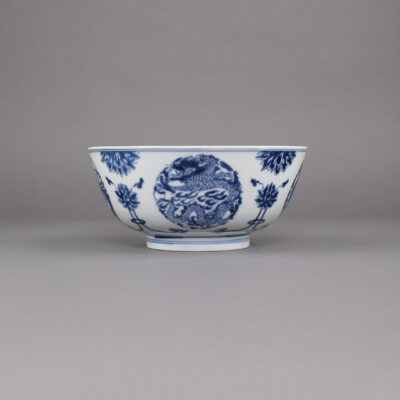
£16,500Chinese porcelain blue and white circular deep bowl, thinly potted with upright sides, painted on the exterior with two pairs of dragon and phoenix medallions, one dragon in pursuit of a white flaming pearl, the other in pursuit of a blue-glazed pearl, whilst one phoenix bird in flight looks back and the other forward, between lotus flower heads on stylised interlinked branches beneath further lotus flowers, all between underglaze blue double lines, the interior painted in the well with a similar pair of lotus flower heads interlinked beneath a ji character, auspicious, within a double ring, beneath a band of lotus flower heads and branches.
The base with a six-character mark of Kangxi within a double ring in underglaze blue and of the period, 1662-1722.
7 5/8 inches, 19.3 cm diameter.
