


21 – S1439
Description
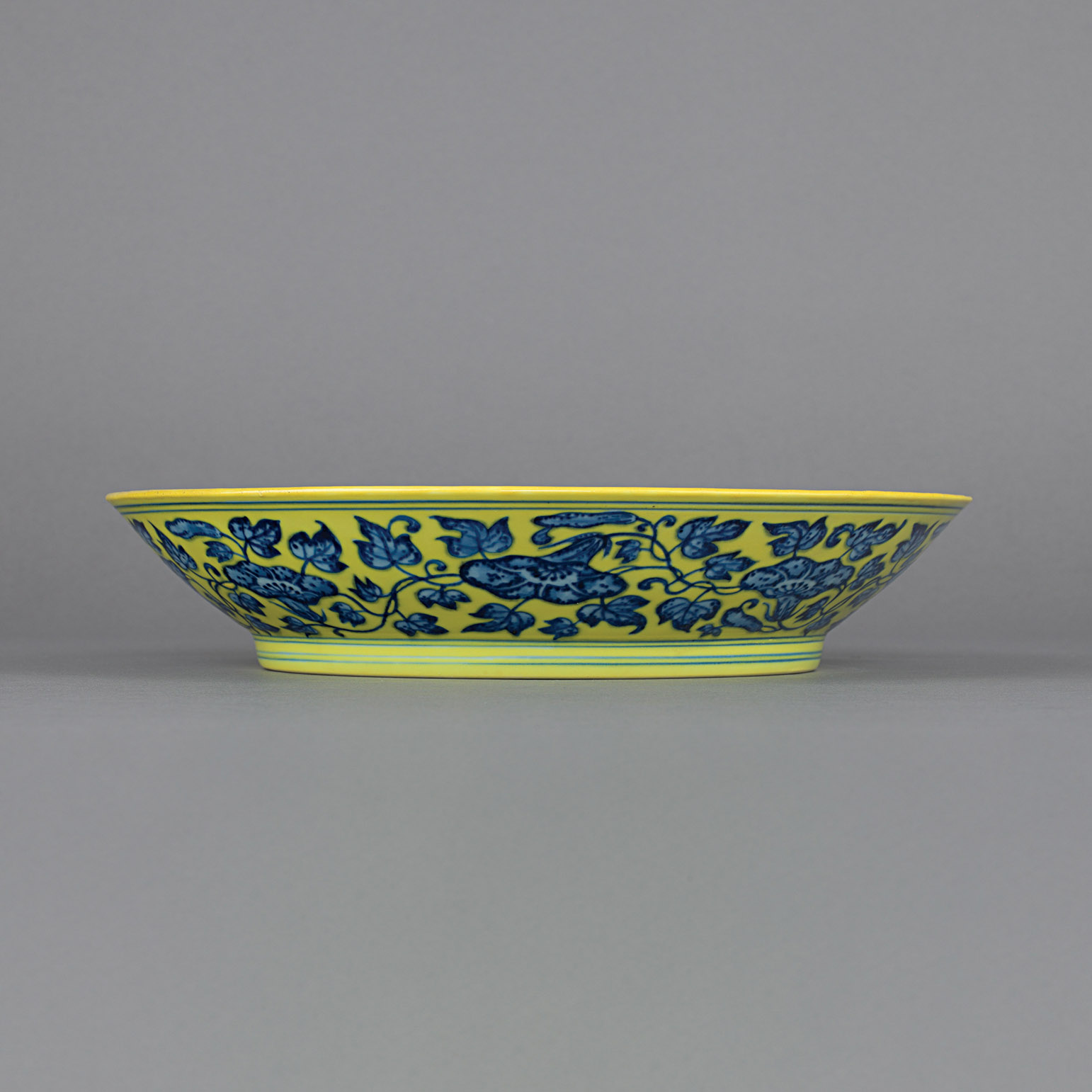
Chinese imperial porcelain lemon-yellow ground underglaze blue decorated nine peach dish, pan, of slightly conical form with gently flared rim, painted in the centre with two leafy branches bearing nine peaches in early Ming style with heaped and piled effect, all within two double lines in underglaze blue, the underside painted with continuous scrolling branches of entwined morning glory with nine flowerheads amongst large leaves and buds, within double lines in underglaze blue with a further double line on the foot rim.
The base with a six-character sealmark of Qianlong in underglaze blue on white reserved on a lemon-yellow ground and of the period, 1736-1795.
10 7/16 inches, 26.5 cm diameter.
26.7cm diameter
Condition
Overall in excellent condition.
Provenance & Additional Information
- From the collection of Harry Nail, Palo Alto, California.
- From the collection of John Yeon, Portland.
- Sold by Christie’s New York in their auction of Fine Chinese Ceramics and Works of Art, 22nd March 2007, lot 331, pp. 244/5 (one of a pair).
- Included by Marchant in their Recent Acquisitions catalogue, 2008, no. 39, pp. 88/9 (one of a pair).
- A similar pair from the collection of T. Y. Chao were included in the exhibition of Ch’ing Porcelain from the Wah Kwong Collection, Chinese University of Hong Kong, 1973, no. 45; another in the National Palace Museum, Taipei, is illustrated in Blue and White Ware of the Ch’ing Dynasty, Book II, Hong Kong, 1968, pl. 29; another in the Percival David Collection, British Museum, is illustrated by Margaret Medley in Oriental Ceramics, The World’s Great Collections, Volume 6, Percival David Foundation of Chinese Art, Tokyo, 1982, no. 247.
- A further example was exhibited by the Osaka City Museum in their 1992 exhibition of Qing Porcelain, no. 127, where the exhibition included a yellow ground Qianlong vase with peaches, no. 128, both p. 45; a further example is illustrated by Claire Déléry in the 2017 exhibition of Porcelaine Chefs-d’Oeuvre de la Collection Ise, Musée Guimet, Paris, no. 60, pp. 168/9.
- Nine peaches, jiutao, form the rebus jiutao xianshou, “nine peaches offering longevity”. Nine, jiu, is a pun on the word “eternity”, and is also the highest yang (male principal) number.
Similar Items
4 - M5388
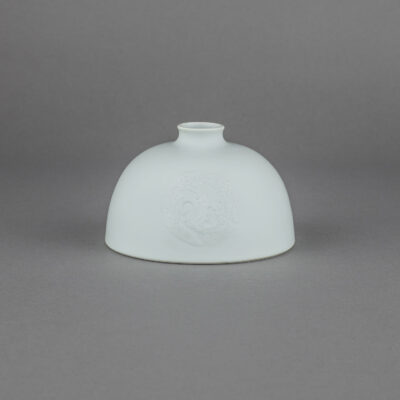
A very fine and rare Chinese imperial porcelain white-glazed waterpot of beehive form, taibaizun, with gently flared lipped rim, moulded and carved with three relief archaic-style dragon and phoenix medallions, covered overall in an even sweet-white glaze.
The base with a six-character mark of Kangxi in underglaze blue and of the period, 1662-1722.
5 ⅛ inches, 12.9 cm diameter of base.

M2516
£8,500Chinese porcelain underglaze blue and white large dish painted with four figures in a walled garden scene with a building to the right, the underside with three ruyi designs.
28.4 cm, 11 1/8 inches.
Tianqi, 1620-1627.

M5395
Chinese porcelain blue and white and underglaze copper-red large ovoid jardinière with gently lipped rim, painted in a continuous mountain river landscape scene with a fisherman in his boat and another casting his net from a rocky promontory beside a willow and viewing pavilion, with large pine trees and underglaze copper-red wutong with two other standing scholars looking across the lake amongst rockwork, plants, pavilions all between underglaze blue lines, the base unglazed.
10 ½ inches, 26.7 cm high; 13 inches, 33 cm wide.
Kangxi, 1662-1722.
