


R1407
Description
Chinese imperial porcelain doucai tripod censer, san zu lu, painted on the body with the Eight Buddhist Emblems, bajixiang, each ribbon tied amongst scrolling lotus and peony flowerheads on branches with scrolls and leaves, beneath a yellow ground ruyi-head band, between two curved openwork handles with open-winged iron-red bats and aubergine bats at the terminals, the flat sides with keyfret, with a lotus flowerhead interlinked branch on the neck above a green-washed band, the relief galleried rim with iron-red keyfret, all on three cabriole feet with flowerheads and branches linked by ruyi-heads, above further keyfret at the foot.
The rim with a six-character sealmark of Qianlong written in a line within a double rectangle in underglaze blue and of the period, 1736-1795.
11 ⅛ inches, 28.3 cm total height.
Provenance & Additional Information
- From an English private collection, North Yorkshire.
- Sold by Tennants Auctioneers in their Autumn Fine Sale, 12th November 2022, lot 309.
- A slightly larger complete garniture of identical pattern from the collection of G. Hohler, presented by Lord Kitchener to Sir Thomas Hohler, K.D.M.G., C.B., J.P., was sold by Sotheby’s London in their auction of Fine Chinese Ceramics and Korean Ceramics and Works of Art, 16th & 17th December 1980, lot 677, pp. 174/5, and again by Sotheby’s London in their auction of Fine Chinese Ceramics and Works of Art, 11th May 2011, lot 230, pp. 171-177, and front cover (enlargement); a slightly larger incense burner of this form in a similar doucai pattern with lotus scrolls and Buddhist emblems is illustrated by Geng Baochang in Gugong bowyuan cang gu taoci ciliao xuancui, Selection of Ancient Ceramic Material from the Palace Museum, Beijing, 2005, Volume II, pl. 214.
- A complete floral doucai garniture is illustrated by Regina Krahl in Chinese Ceramics from the Meiyintang Collection, Volume Four (II), London, 2010, 1752, pp. 275-277.
- The bajixiang are the Eight Auspicious Emblems of Buddhism and consist of the Wheel of Law, lun; the Conch, luo; the Standard of Victory, san; the Parasol, gai; the Lotus, hehua; the Vase, guan; the Twin Fish, yu and the Endless Knot, panchang. The symbols originated in India, becoming well established in the art of Tibetan Buddhism, and were used in China from the Yuan These symbols became standardised on official porcelain for the Palace from the early Ming dynasty and were particularly popular under the Yongzheng and Qianlong Emperors’ reigns.
Condition
Overall in excellent condition, without any chips,crcaks,or restoration.

Similar Items
14 - M5280
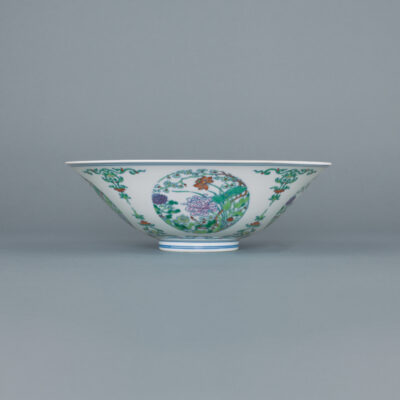
Chinese imperial porcelain doucai and famille rose enamelled conical floral medallion bowl, wan, painted on the exterior with four blossoming flower medallions of peony, lotus, chrysanthemum and prunus, representing the four seasons, the branches and leaves forming the roundel, all between stylised green-glazed branches with buds and lotus petals, beneath two underglaze blue lines at the rim repeated on the foot. The well of the interior with a double butterfly medallion and a prunus flower spray, circled by two pairs of underglaze blue double lines.
The base with a six-character mark of Yongzheng within a double ring in underglaze blue and of the period, 1723-1735.
12 ⅝ inches, 32.2 cm diameter.
13 - M5094
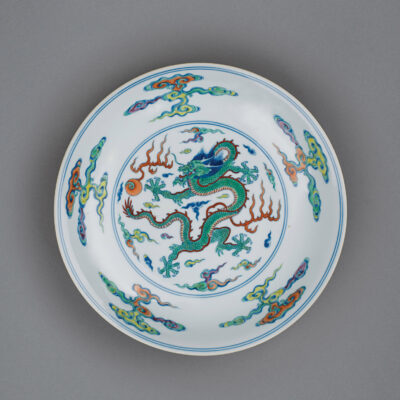
Chinese imperial porcelain doucai dragon saucer dish, pan, painted in the centre with a five-clawed dragon with open mouth and detailed scales in pursuit of a large iron-red flaming pearl, amongst stylised flames and ruyi-clouds all within two underglaze blue lines, the cavetto painted with five large ruyi-clouds in iron-red, aubergine, green and yellow enamels outlined in underglaze blue within two further underglaze blue lines beneath the rim. The underside with a wide band of crested foaming waves beneath clouds, all within underglaze blue double lines.
The base with a six-character mark of Yongzheng within a double ring in underglaze blue and of the period, 1723-1735.
7 ⅞ inches, 20 cm diameter.
1 - M5144
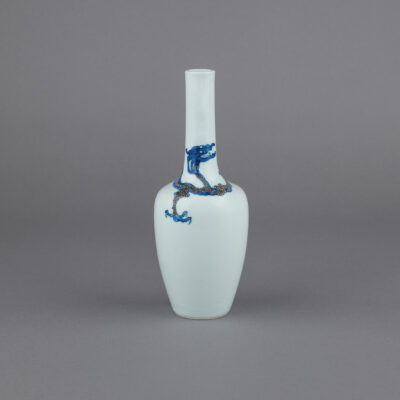
Chinese imperial porcelain underglaze blue and copper-red bottle vase with tapered baluster body, chang jing ping, tall cylindrical neck and lipped rim, painted with an open-mouthed three-clawed chilong dragon encircling the body, the scales in underglaze copper-red.
The base with a four-character mark of Kangxi within a double ring in underglaze blue and of the period, 1662-1722.
8 ¾ inches, 22.3 cm high.
