


20 – M5145
Description
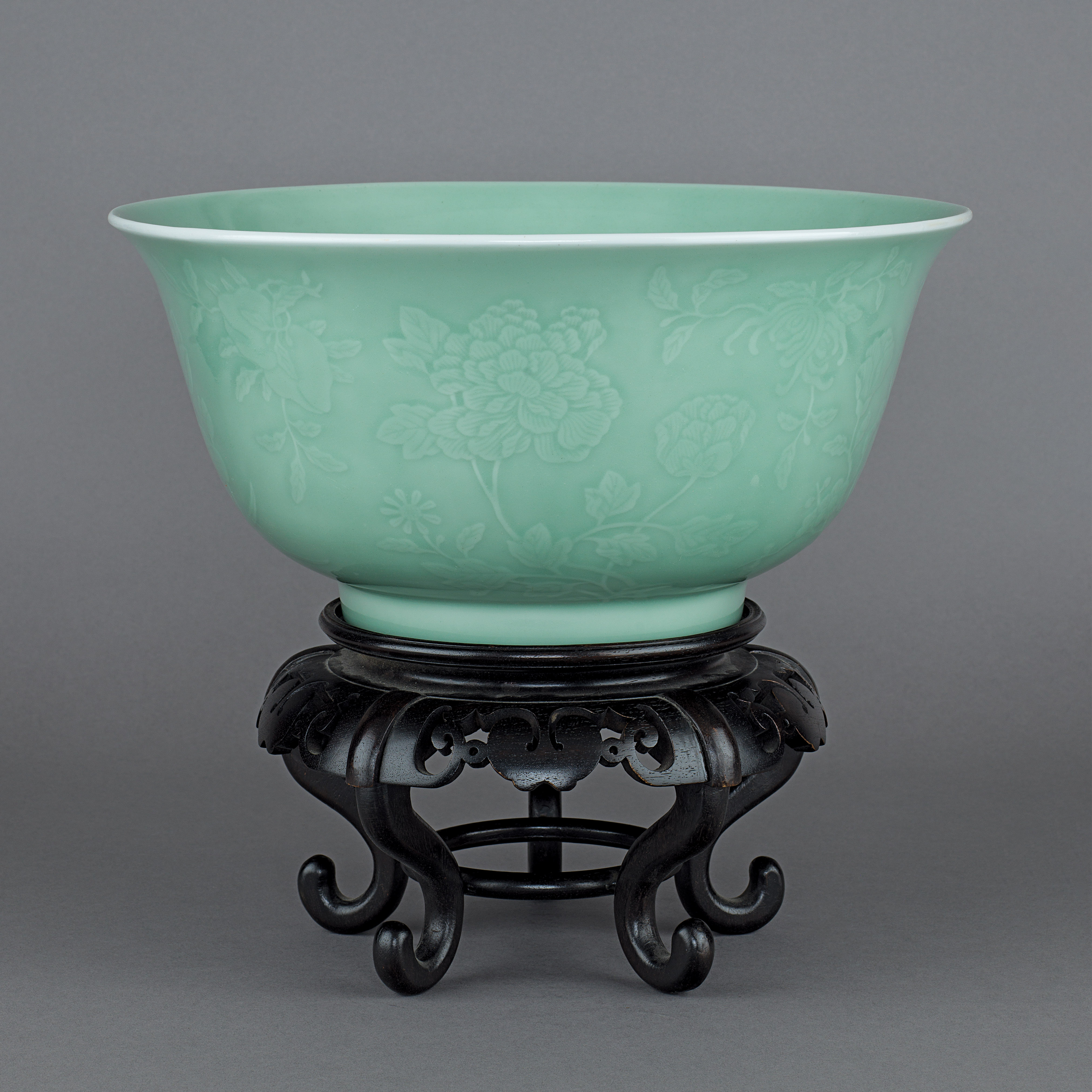
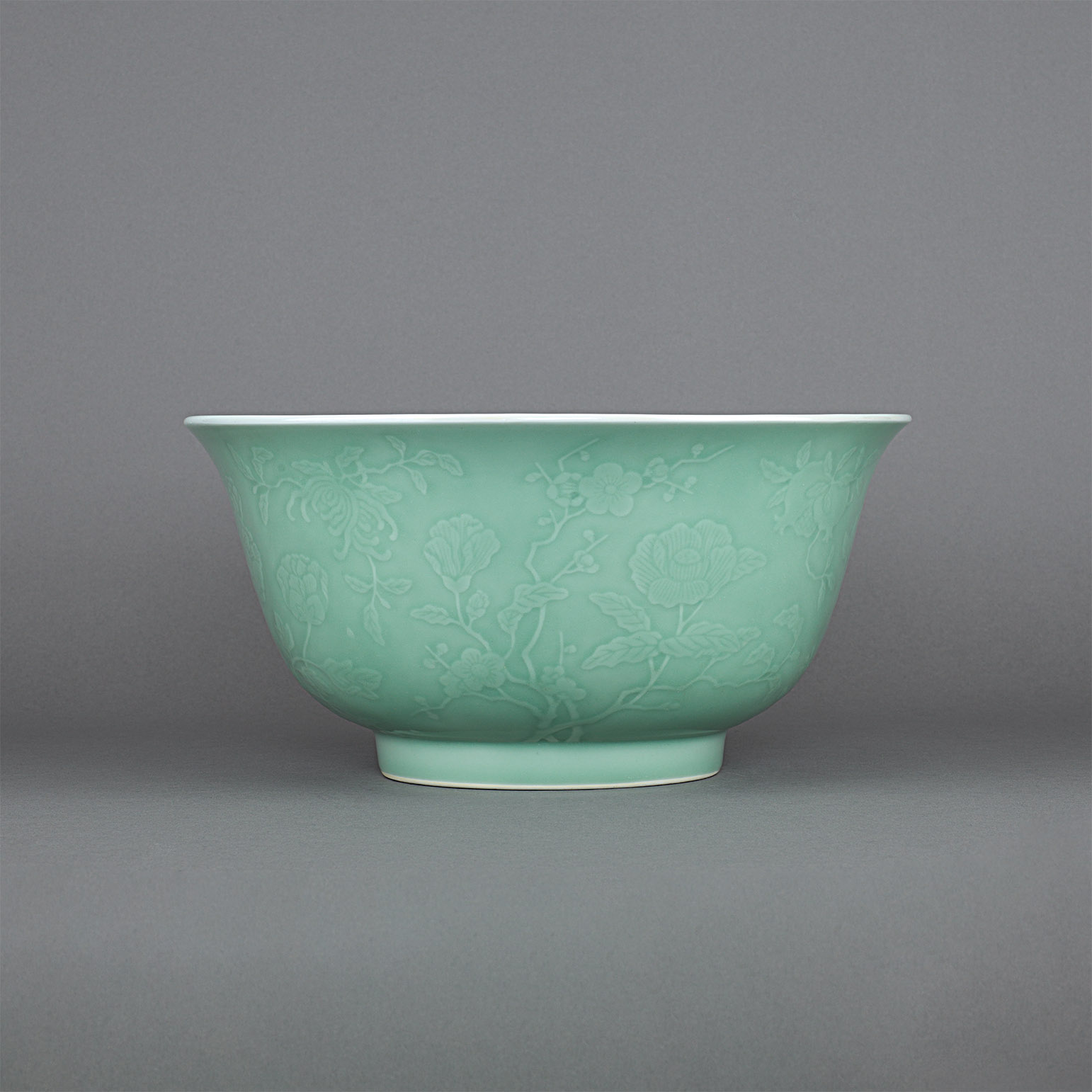
Chinese imperial porcelain large celadon-glazed moulded and carved deep bowl, wan, with flared white-glazed rim and slightly inverted foot decorated on the exterior with large sprays of lotus flowers, leaves and buds, fruiting peach branch, peonies, a pink flower, finger citron, prunus, camellia, fruiting pomegranate, tree peony and fruiting lychee, covered overall in a rich and even luminous celadon glaze, extending to the interior and the base.
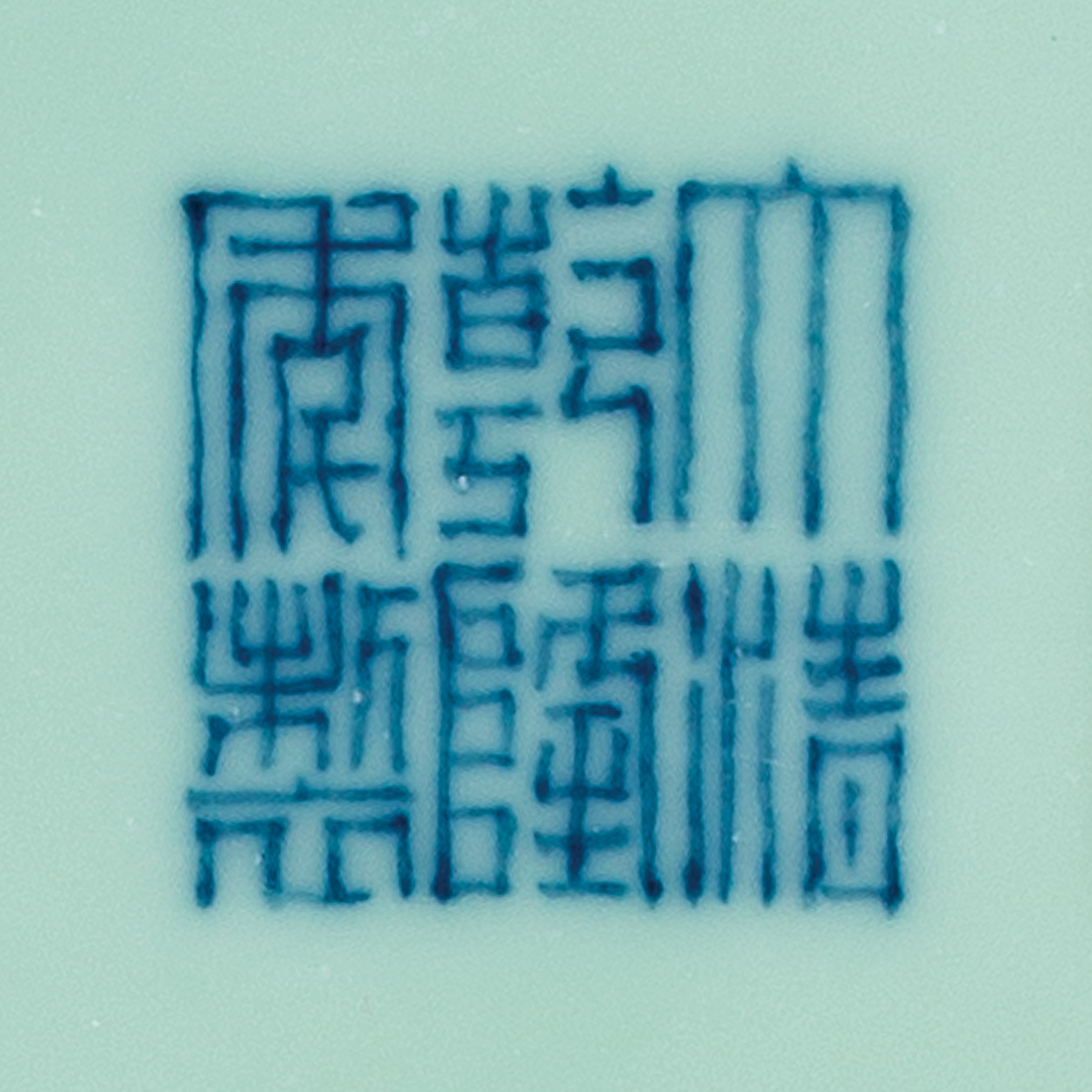
The base with a six-character sealmark of Qianlong in underglaze blue and of the period, 1736-1795.
13 ¼ inches, 33.8 cm diameter.
Provenance & Additional Information
- From the collection of Ho-Ching (1900-1963) and Mme. Von Sung Yang (1903-2005), acquired between 1939 and 1955 and thence by descent, together with label E/O Von Sung Ya, 40026807 38DSL.
- Sold by Sotheby’s New York in their auction of Important Chinese Art, 23rd September 2020 and thence by descent, lot 532, 44/5.
- The pair to this bowl, of inferior quality and condition, from the same collection, was sold by Sotheby’s New York in their auction of Fine Chinese Ceramics and Works of Art, 16th September 2009, lot 218, 76.
- An identical example from the Jingguantang Collection, the Tsui Museum of Art, Hong Kong, was published in Chinese Ceramics V; Qing, Hong Kong, 1995, 36, and was sold by Christie’s Hong Kong in their auction of The Jingguantang Collection, Magnificent Chinese Works of Art, 3rd November 1996, lot 570, and was then published by Regina Krahl in Chinese Ceramics from the Meiyintang Collection, Volume Four (II), London, 2010, no. 1804, p. 353, then sold by Sotheby’s Hong Kong in their auction of The Meiyintang Collection, Part IV, 9th October 2012, lot 33, pp. 124-127, where it notes, “bowls of this form and with this design of flowers and fruits of the four seasons were made in both Yongzheng (AD 1723-35) and Qianlong (AD 1736-95) periods. The former also with a reign mark inscribed in seal script, but usually with a celadon glaze of more bluish tone. A Yongzheng example from the Anthony de Rothschild Collection is illustrated by Regina Krahl in The Anthony de Rothschild Collection of Chinese Ceramics, Volume Two, 1996, no. 144”.
- Pomegranate, shiliu, peach, tao, and finger citron, fushou, form the rebus fushou sanduo, “may you have an abundance of blessings, sons and longevity”. Added here is lychee, lizhi, which is homophonous with the word lizi, meaning to have a son as so to continue the family name. Lizhi is also a pun on “clever”.
Condition
Overall in excellent condition, without any chips,crcaks,or restoration.

Similar Items

M5538/9
Pair of Chinese imperial porcelain large moulded celadon-glazed bowls, wan, of deep form with upright sides and straight footrims, each moulded on the exterior with six peony blooms on their characteristic leafy branches beneath an archaic scrolling band at the rim and above a keyfret band at the foot, the interior incised overall with a central peony flowerhead encircled by six further blooms on a continuous scrolling branch with leaves beneath a keyfret band at the rim, the rims glazed white, covered overall in a luminous even pale celadon glaze.
Each base with a six-character sealmark of Qianlong in underglaze blue and of the period, 1736-1795.
10 ½ inches, 26.7 cm diameter.

M5756
£23,500Chinese porcelain lavender blue glazed vase of fluted baluster form with eight petal ribbed lobes, the central bulb above a gently waisted splayed foot and beneath a slightly flared rim, the interior glazed white, covered overall on the exterior in a rich and even bright lavender blue glaze, pooling and thinning at the ridges and flutes, the base unglazed revealing the pure biscuit body.
Yongzheng, 1723-1735
17 inches, 43.2 cm high

R1058
£58,000Chinese imperial porcelain blue-glazed altar vessel and cover, dou, modelled after an archaic bronze with moulded and carved archaic designs, the upright body with ribs and bands all on a splayed, ribbed foot, the cover with a design of scrolls, fretwork and registers of stylised waves beneath a double-rope twist openwork finial, covered overall including the interior and underside in a deep and even blue glaze.
27.5 cm high.
The interior of the cover and the underside with six-character sealmarks of Qianlong and of the period, 1736-1795.
