


Imperial
To tell the story of Imperial Chinese porcelain is in some ways to tell the story of China itself. Fascinating, vibrant, richly varied and a beautiful artform that has beguiled, intrigued and captivated the rest of the world for millennia.
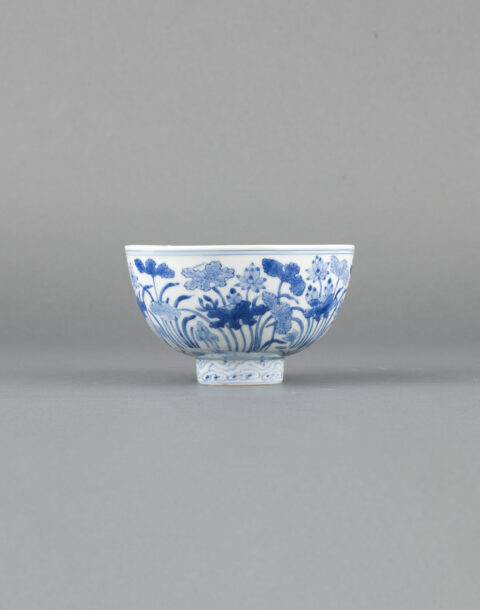
Chinese Imperial porcelain, often known as Imperial ware in China (Guan yao), is porcelain specifically manufactured for the Chinese emperor and the Imperial household. The first Imperial kiln was founded during the second year of the Ming dynasty (1369) in Zhushan (Pearl Hill) in the southern city of Jingdezhen.
The official kilns making Imperial Chinese porcelain in Jingdezhen were established in the fourteenth century and pieces of Chinese Imperial porcelain produced at the factory were marked with an official nian hao, or reign mark. The marks were applied to the pieces by a very small number of highly specialised craftsmen, some of whom spent their entire working lives painting the same nian hao.
-

M5375
£38,000Chinese imperial porcelain large dish, brightly painted in famille rose, fencai enamels with bajixiang, the eight auspicious emblems, each ribbon tied and amongst eight different flowering branches in pink, blue, light blue, turquoise green, iron red, gilt, yellow, white and lime green enamels encircling a stylised central flowerhead with interlinked other flowers, all within a double gilt border, the rim with a wide band of pink ruyi-heads on a lemon yellow ground, the underside with three different flower sprays each on a leafy branch with other flowers and leaves.
-
M5095
£35,000Chinese imperial porcelain fencai large thickly potted dish, finely painted with five-clawed iron-red and blue dragon on each side of a flaming gilt pearl, all amongst stylised ruyi-clouds and flames within a wide gilt band, the underside with an aubergine dragon and another iron-red dragon with two pearls amongst stylised clouds and flames.
-
M4566/NF2
£58,000Chinese imperial porcelain yellow ground saucer dish incised in the centre and painted with a green and aubergine five-clawed dragon in pursuit of a flaming pearl amongst stylised flames, within a double aubergine ring, the underside decorated with grapes and leaves also on a yellow ground extending to the base.
-
R9952
£30,000Chinese imperial porcelain saucer dish painted on a yellow ground and incised with a green and aubergine five-clawed dragon encircling a flaming pearl amongst stylised clouds and flames, the underside with aubergine grapes and green leaves on a yellow ground extending to the base.
-
M3292
£POAA Chinese imperial cloisonné bottle vase with rounded body and ribbed cylindrical neck, the body decorated with stylised lotus flower heads amongst leaves and scrolling branches, beneath stylised peony flower heads and further lotus flower heads beneath the rim, all on a turquoise ground, two of the raised ribs with a dark blue ground, the foot with scrolls and jewels.


Further information
Over the centuries, the royal court generated massive demand for Chinese Imperial porcelain, now highly collectable antiques. Imperial China had main palaces and residences and the royal princes had subsidiary regional courts. There were also many regional temples that required Imperial ware. In China, each household rank was entitled to a very specific collection set out in a written list. The last of which was produced in 1899 and specified that:
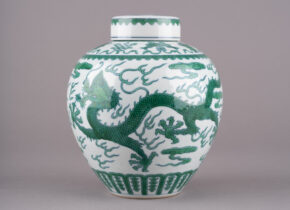
The Empress Dowager Cixi received 821 pieces of Imperial yellow Chinese porcelain, the Empress received 1,014 pieces, a concubine (first rank) received 121 pieces of Imperial yellow Chinese porcelain with a white interior and a concubine (second rank) received 121 pieces of Imperial yellow Chinese porcelain decorated with green dragons.
As more and more Imperial ware from China made its way into international collections, especially the cobalt blue designs from the Ming dynasty, Chinese Imperial porcelain developed a major influence over the world’s most famous design houses, most notably Delftware from the Netherlands.
The Kangxi Emperor (1661 – 1722) revived the Imperial Chinese porcelain factories in Jingdezhen after a 60-year period of dormancy. Under his reign, and of his successors Yongzheng and Qianlong, the Imperial Chinese porcelain factories flourished. Not only did they take inspiration from their predecessors, they combined it with amazing developments in production techniques to make exceptionally high quality Imperial ware. China, for example, led the way in the development of many of the techniques still in use today, including the development of opaque overglaze enamel colours that allow artists to create a much broader range of shades and hues.
You should also check

Japanese & Korean
Japanese and Korean ceramics.

Paintings
Chinese paintings, typically gouche and watercolour.

Famille Verte from Private Collections
18 piece exhibition of Chinese famille verte porcelain, Kangxi period. 28th October – 12th November 2021.
