


Blue & White
Practically speaking, Chinese blue and white porcelain is contrived using a blue pigment from cobalt oxide. It creates designs on clean white clay which is glazed and fired at high temperatures, but the history of blue and white Chinese pottery is much more poetic.
Blue and white ceramics hold a special significance in the rich and varied history of China’s pottery industry and the origin of the famous blue gained recognition during the Tang dynasty (618 – 907). However it wasn’t until the Mongolian-ruled Yuan dynasty (1279 – 1368) that the production techniques of what has become antique blue and white stoneware reached maturity.
As the Silk Road trade route flourished, cobalt ores were imported from Persia and were an extremely expensive and scarce commodity used only sparingly, hence why blue and white China antique vases, bowls and plates are highly desired by collectors, both for their beauty and their scarcity.
The Yuan artisans took extraordinary pride in their work because it had a mythological, almost religious element, the Yuan mythical animal large charger in the Ashmolean Museum, Oxford (collection number EAX.1707) is a classical representation.
Chinese blue and white porcelain has always been highly prized, often reserved for diplomatic gifts and special occasions.
-

M4832
£POAChinese porcelain blue and white circular seal paste box and cover, he, the cover painted with Chang’E, the Moon Goddess, presenting an osmanthus branch to scholars visiting her in the Moon Palace whilst standing on clouds, Chang’E between two lady attendants holding fans and another with a banner, all on a terrace scene beneath overhanging branches, the male scholars on a blue washed stippled ground, the interior of the cover with Li Bai standing beside his attendant holding a wine jar, the box base with a continuous ‘master of the rocks’ river landscape scene with fishermen in a boat and a viewing pavilion, the interior of the base with Liu Hai standing beside his three-legged toad, the underside with a two character mark Qing wan, ‘pure plaything’, within a double ring.
-
5 – M5503
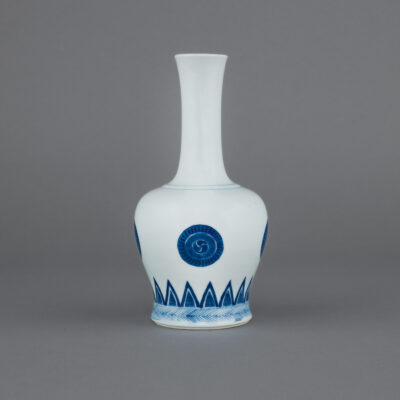
£POAChinese imperial porcelain blue and white slender necked baluster vase, of handbell form, yaoling zun, painted on the body with four circular medallions consisting of three bands forming the gankyil, “Wheel of Joy”, above stylised upright pointed leaves with scrolls and a wide herringbone band at the gently flared foot, the shoulder with a single rib within two lines.
-
6 – M4918
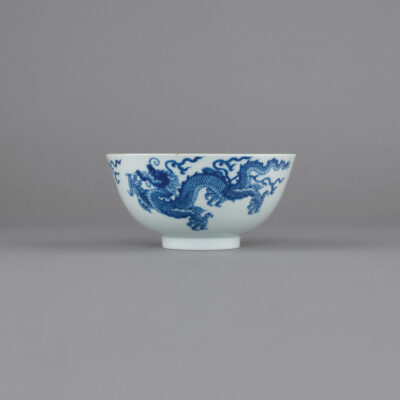
£POAChinese imperial porcelain blue and white dragon bowl, wan, thinly potted with gently rising upright sides on a short foot rim, painted with two five-clawed dragons with detailed scales and open mouths, each in pursuit of a flaming pearl, amongst stylised flames, the interior glazed white.
-
M4641
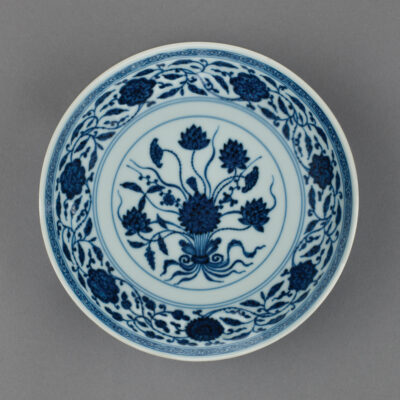
£38,500Chinese imperial porcelain blue and white “lotus bouquet” dish with gently rounded sides rising from a short tapering foot to a slightly everted rim, painted in rich cobalt-blue tones to the interior with a roundel enclosing a ribboned bouquet of lotus flowers, aquatic plants and a lotus pod, encircled by three concentric rings, the cavetto and exterior painted with seven alternating flowerheads amidst scrolling foliage, all below a classic scroll band.
-
M4925
£65,000A Chinese porcelain blue and white jardinière modelled as a wood barrel, painted on the exterior with a wide band of two carp, a mandarin fish and another fish swimming amongst aquatic plants and lotus flowers, leaves and arrowheads above crested waves and rocks, the foot with a wide band of stylised ruyi, all beneath a blue ground relief band with triangular blue ground diaper of branches and relief blue studs imitating the metal original, beneath an incurved rim painted with a continuous scrolling branch, the slightly recessed base unglazed.
-
M5377
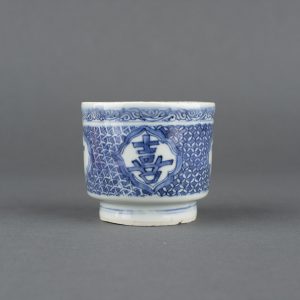
£POAChinese porcelain blue and white, underglaze copper-red and celadon brush pot, bitong, painted and carved in a continuous mountain river landscape scene, with a fisherman in his boat moving towards a village and a viewing pavilion nestled amongst the mountains, with elaborate pine tree and wutong and another viewing pavilion on a rocky promontory, beneath clouds and the setting sun, the unglazed base with recessed glazed centre in imitation of a turned-wood brush pot.
-
M5395
£POAChinese porcelain blue and white and underglaze copper-red large ovoid jardinière with gently lipped rim, painted in a continuous mountain river landscape scene with a fisherman in his boat and another casting his net from a rocky promontory beside a willow and viewing pavilion, with large pine trees and underglaze copper-red wutong with two other standing scholars looking across the lake amongst rockwork, plants, pavilions all between underglaze blue lines, the base unglazed.
-
M5505
£POAA Chinese porcelain large blue and white vase of slender form, decorated with a scene from the “Romance of the Western Chamber” with Zhang Sheng thanking General Du Que for saving his love Cui Yingying, surrounded by various high-ranking soldiers and officials inside the General’s tent with draped curtains and banners, the surrounds decorated with large varying trees and rockwork all beneath clouds, the neck with flower sprays and rockwork above a triangular diaper band, the base glazed-white and decorated with a ribboned artemisia leaf within a double-circle of underglaze-blue.
-
M5725
£26,500Chinese porcelain blue and white beaker vase, gu, decorated with four panels of buddhist lions perched atop rockwork, amongst waves, flames and clouds, the central bulb enclosed by two protruding ribs and key-fret borders decorated with flowers and scrolling foliage, the rim and foot with scrolling ruyi clouds, the base glazed white with a double-ring mark in underglaze blue.
-
M5731
£12,500A large Chinese porcelain blue and white ovoid ginger jar and cover, painted with lozenge shaped panels of fans, each depicting a figure with his arms raised looking at beehives, between tied bunches of lotus above branches of peony, the original cover with antiques.
-
M5737/8
£12,500A pair of Chinese porcelain blue and white thinly potted saucer dishes each fluted bodies foliate rims, painted with a scene from Xixiang ji, The Romance of The Western Chamber with Zhang Sheng meeting Cui Yingying in a terraced garden scene between a tree, beside an interior with table and stools, all beneath clouds, each underside with two landscapes and viewing pavilions.
-
M5758
£32,000Chinese porcelain blue and white bottle vase with rounded body and tall flaring neck, painted with four full-facing dragons amongst stylised flames and clouds, each encircling a flaming pearl in a stylised flowerhead reserve, above a band of crested waves and rock work on a flared foot, the neck with phoenix bird medallions above a band of wan characters and ruyi-heads, beneath a further band of ruyi-heads at the flared rim.
-
M5761
£8,500A Chinese porcelain blue and white vase of double gourd form, painted on the body with blossoming prunus on a cracked-ice ground with “blobby dots” on the rim, the underside with a leaf mark within a double ring.
-
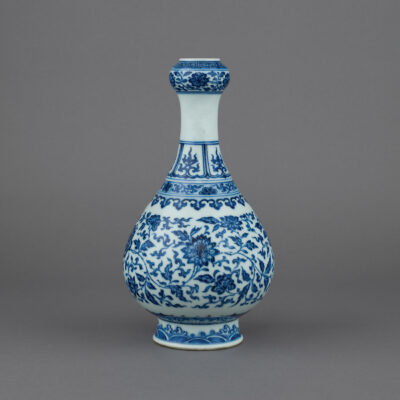
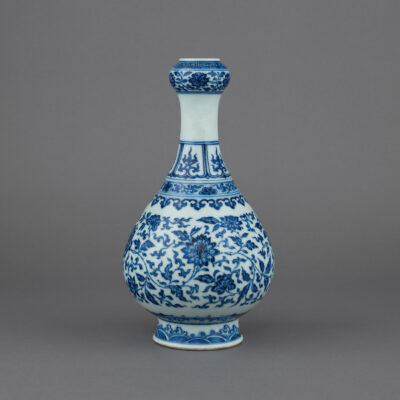
18 – SMBM3
£POAChinese imperial porcelain blue and white bottle vase, suantou kou ping, with pear-shaped body, everted lipped foot, garlic mouth and upright rim, painted on the body with twelve seasonal blooms borne on a continuous scrolling branch with characteristic leaves including peony, chrysanthemum, camellia, hibiscus and lotus, beneath a ruyi-head band and a blue washed prunus flower head band at the ribbed shoulder, the neck with lappets of branches and leaves beneath the garlic mouth painted with flowerheads and their characteristic leaves beneath a keyfret band at the upright rim. The foot painted with a crested wave and foam band beneath blue ground lappets, painted overall in the classic Ming style with heaped and piled effect.
-
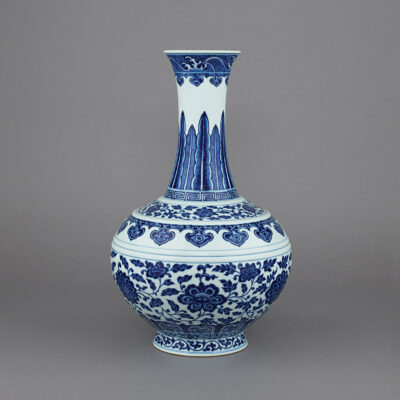
22 – M4826
£POAChinese imperial porcelain blue and white bottle vase, shang ping, painted in the Ming style with heaped and piled effect, with globular rounded body and four wide relief ribs, tall cylindrical flared neck and slightly splayed foot, painted on the body with six different large flowerheads on a continuous scrolling branch beneath six smaller flowerheads each with its characteristic leaves, including lotus, peony, chrysanthemum and camellia, above a wide band of blue wash ground lappets and beneath bands of ruyi-heads and different flowers on a scrolling branch at the shoulder, the neck with tall leaves above a keyfret band, beneath a further ruyi-head band with a crested wave band beneath the rim, the splayed foot with a scrolling branch.
-
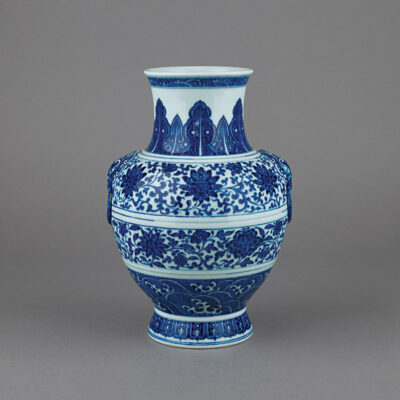
25 – M4743
£POAChinese imperial porcelain blue and white vase of zun form, painted in the Ming style with heaped and piled effect, the body with two wide bands, the lower register with six different large flowerheads and twelve smaller flowerheads, all on continuous scrolling branches with their characteristic leaves, including peony, lily, rose, poppy, pink, camellia and mallow, beneath a band with six large lotus flowerheads on a continuous scrolling leafy branch with smaller flowerheads, all between six relief ribs above a wide band of swirling crested waves and a further rib above lappets on the splayed foot, all between two high relief taotie animal mask and ring handles, the neck with formal archaic style leaves, beneath a further crested wave band at the rim.
-
30 – SMBM5
£POAPair of Chinese imperial porcelain blue and white moonflasks, bian hu, each with ruyi-head terminal handles, flared rim and everted foot, painted on each side with peach-shaped relief panels of five large fruiting peaches on a singular leafy branch between a pair of bats in flight encircled by scrolling branches of lotus and camellia within underglaze blue double lines, the flat sides with a continuous scrolling branch of fruiting lingzhi between pairs of double lines, the neck painted with a band of lotus beneath ruyi-heads and a floral band with scrolling leafy branches at the rim, the foot with a continuous band of leaves and branches.
-
R1050
£POAA Chinese porcelain blue and white ewer in the form of a frog, the body moulded and the skin stippled on a blue washed ground with prunus flower-heads, the head of the frog with bulbous eyes and cylindrical mouth forming the spout, the back with an open aperture and gently flaring rim, between the upright loop handle decorated with flower heads and leaves, the flat base unglazed.







Further information on Blue & White
During the early Ming dynasty (1368 – 1644), the supply of cobalt oxide from Persia was briefly halted due to foreign trade restrictions and a locally-mined cobalt was used. It’s high concentration of manganese resulted in a softer, more pale blue and it continued to be used all the way through the reigns of emperors Xuande, Chenghua and Zhengde through the fifteenth and early sixteenth centuries.
It was also at this time that smalt cobalt – achieved by mixing cobalt oxide with molten glass and brought to China by Zheng He’s maritime expeditions – was used to create stunning blue and white Chinese pottery. It resulted in brilliant blues visible in the glazed surfaces of blue and white china antique plates, blue and white china antique vases and blue and white china antique bowls.
As was their wont, the desirability of what has become antique blue and white stoneware was largely dependent on the tastes of each emperor. The fifth Ming emperor Xuande enjoyed Mineral Blue (shizi qing) from Jiangxi province mixed with Muslim Blue (huiqing) from predominantly Central Asia. This generated a deeper purplish-blue tone while the favoured blue and white Chinese porcelain of the ninth Ming emperor Chenghua used the locally-sourced cobalt with high concentrations of manganese, resulting in a paler hue for the blue and white ceramics produced for his Imperial court.
You should also check

Famille Verte from Private Collections
18 piece exhibition of Chinese famille verte porcelain, Kangxi period. 28th October – 12th November 2021.

Famille Rose
Objects of the aforementioned colour palette primarily identified by the use of a pink enamel.
The Centenary Exhibition
The Centenary Exhibition – Imperial Porcelain of Kangxi, Yongzheng and Qianlong.
27th October – 7th November 2025
