


Ming & Earlier
Perhaps the most well-known of all Chinese ceramics, Ming dynasty porcelain benefitted from China’s return to Han Chinese rule in 1368 after 97 years of the foreign Mongol-led Yuan dynasty. As the internecine struggles abated, Ming pottery flourished in the world-famous ‘porcelain town’ of Jingdezhen and beyond.
Out were the old tastes of Song dynasty monochromes and in were the new appetite for Ming dynasty blue and white porcelain. Not without coincidence, the desire for Ming dynasty ceramics was exacerbated both by China’s economic upturn in the fifteenth century as it shifted towards a market economy and at the same time the European renaissance led to thousands of pieces of spectacular Ming porcelain making their way from China to become prized possessions in Europe’s royal palaces and stately homes.
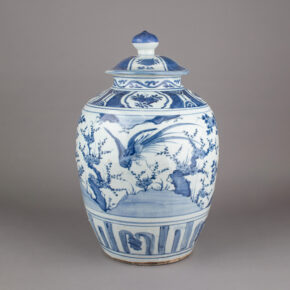
As Ming dynasty porcelain continued its journey of refinement, there were significant innovations that became benchmarks in the rich and detailed history of Ming pottery including jihong under the Xuande emperor (a blood-red glaze of which it is believed there are fewer than 100 remaining examples in museums), doucai (contending colours) under Chenghua, jiaohuang (yellow glaze) under Hongzhi and wucai (five colour) under Wanli. It was also during the reign of Wanli (1572 – 1620) that production techniques, including mixing kaolin clay and pottery stone in equal proportions enhanced the whiteness of the vessel body, enhancing Ming dynasty blue and white porcelain.
-

M4942
£22,500Pair of Chinese celadon glazed small vases and covers of guan form, each carved with flowerheads on a continuous scrolling branch amongst leaves above a wide lappet band with upright leaves and further flowerheads and scrolls on the shoulder, and beneath a triangular band on the gently flared neck, the covers with central raised flowerhead, again above a scrolling flowerhead band, the base glazed, the unglazed foot rim, rim and underside of the cover revealing the biscuit body.
-
M4835/6
£18,000Pair of Chinese porcelain blue and white kosometsuke small food bowls in the form of jardinières, each painted on the exterior with nine branches of bamboo beneath stylised leaves on the flat everted foliate rim.
-
M3102
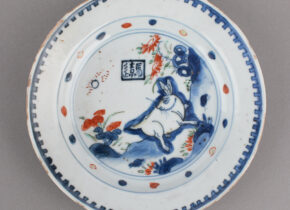
£9,500Large Swatow deep circular dish painted in turquoise, black and iron-red enamels with a large central scene of the ‘split pagoda’, with mountains in the distance, figures crossing a bridge and boats, all above three pagodas on rockwork, surrounded by four ruyi-head flaming medallions of fisherman, two with figures crossing a bridge, one with a fishing boat with one of the fisherman holding a net and the other with a boat in a river scene, between four four-character iron-red seals within a double square, the underside plain, the base and foot rim with sand grit.
-
S2194
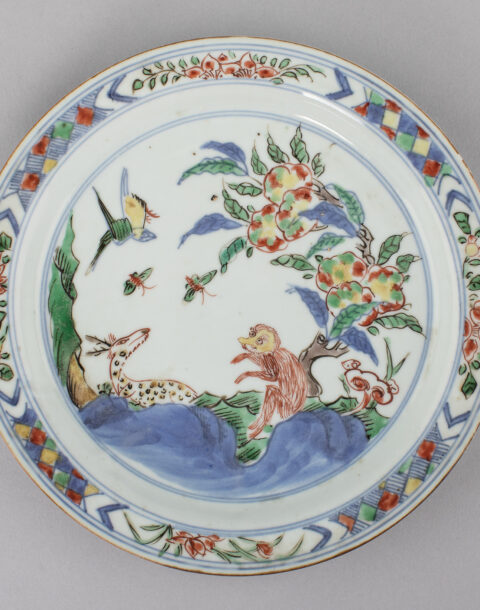
£22,000Large Swatow deep circular dish painted in turquoise, black, iron-red and green enamel with gently everted rim, painted in the centre with a barefoot artist wandering in a landscape holding a branch supporting a long-tailed bird, with a rucksack of scrolls and gourd, a further rolled scroll sits on an easel extending from his rucksack, all beside a deer, rockwork, bamboo and beneath a large chrysanthemum, encircled by a lappet band of flowers and branches, the cavetto painted with four large lobed reserves, two with birds perched amongst aster and camellias and two with lotus flowerheads, all between chilong dragon roundels on an iron-red diaper ground of cash and cross-hatch, the underside plain, the base and foot rim with sand grit.


Further information on Ming & Earlier
Early Ming dynasty ceramics took inspiration from the intricate but busy Islamic styles of the outgoing Yuan Mongols but it wasn’t long before the Han started to exert their own influences on design. From the 15th century onwards, Ming porcelain decoration became more subtle and restrained but as demand grew from Japan and Europe, it once again became more elaborate. It was one of China’s major exports and was often exchanged for Spanish silver. By the sixteenth century, Ming dynasty porcelain included vibrant colours such as blues, reds, greens and yellows.
By the late sixteenth and early seventeenth centuries, it was becoming increasingly common for producers of Ming pottery and Ming porcelain to add imperial reign dates to their wares and there started a trend for artists to sign their wares. A signature on a Ming vase of one of the most highly respected Ming dynasty porcelain artists could dramatically affect its price, such was the reputation of some of the artisan craftsmen of the era, not unlike the European painters of the day.
You should also check
Monochromes
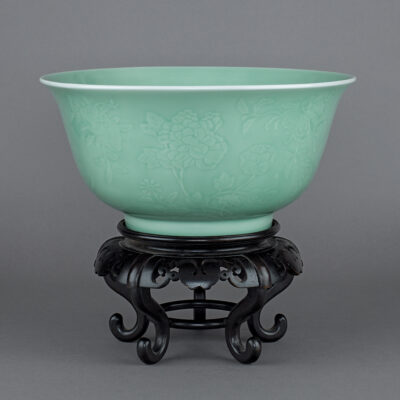
Objects of single-colour.

Bronzes & Works of Art
Bronzes and works of art.

Chinese Ceramics From Tang to Song
Chinese Ceramics Tang to Song coincides with the 25th anniversary of Asian Art in London. The exhibition has been carefully curated and includes 43 pieces with excellent provenance, many of which are the finest examples of their type that the gallery has ever handled in almost 100 years of business.
