


Ming & Earlier
Perhaps the most well-known of all Chinese ceramics, Ming dynasty porcelain benefitted from China’s return to Han Chinese rule in 1368 after 97 years of the foreign Mongol-led Yuan dynasty. As the internecine struggles abated, Ming pottery flourished in the world-famous ‘porcelain town’ of Jingdezhen and beyond.
Out were the old tastes of Song dynasty monochromes and in were the new appetite for Ming dynasty blue and white porcelain. Not without coincidence, the desire for Ming dynasty ceramics was exacerbated both by China’s economic upturn in the fifteenth century as it shifted towards a market economy and at the same time the European renaissance led to thousands of pieces of spectacular Ming porcelain making their way from China to become prized possessions in Europe’s royal palaces and stately homes.
As Ming dynasty porcelain continued its journey of refinement, there were significant innovations that became benchmarks in the rich and detailed history of Ming pottery including jihong under the Xuande emperor (a blood-red glaze of which it is believed there are fewer than 100 remaining examples in museums), doucai (contending colours) under Chenghua, jiaohuang (yellow glaze) under Hongzhi and wucai (five colour) under Wanli. It was also during the reign of Wanli (1572 – 1620) that production techniques, including mixing kaolin clay and pottery stone in equal proportions enhanced the whiteness of the vessel body, enhancing Ming dynasty blue and white porcelain.
-

M4402
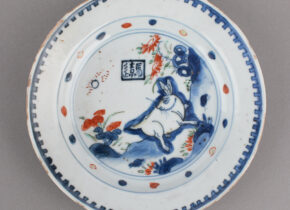
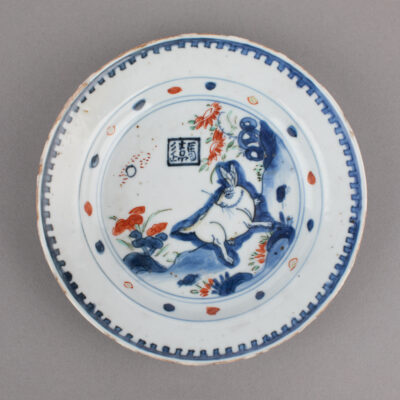
£2,850Chinese porcelain underglaze blue ko-akai, wucai small dish, with flat everted rim, painted in the centre with a large white rabbit looking back on an underglaze blue-wash border between fruiting lingzhi fungus and daisies beneath a couplet with the characters 'Ma Yuan' within a rectangle and the moon beneath a crenelated border at the rim.
-
M462
£POAChinese cloisonné rectangular panel, decorated in the centre with two scholars seated in a viewing pavilion while their attendant brings them a wrapped qin, all amongst palace rooftops in a mountainous landscape scene, with willow, wutong, pine and five other different trees, amongst ruyi clouds, rockwork and bamboo sprays, all in rich colours of lapis, green, white, yellow, brown, red and black on a turquoise ground, encircled by a lapis blue-ground border with continuous stylised branches.
-
M4843
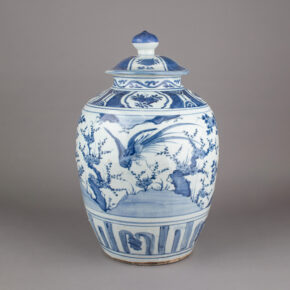
£8,500Chinese porcelain blue and white deep kraak basin, painted in the centre with two pairs of geese, one standing on a rocky promontory, one swimming in a river landscape and a pair in flight, amongst elaborate lotus leaves and rock work beneath the sun, with a wide cavetto with panels of precious objects including fan, scrolls, ruyi-sceptre beneath a foliate rim with mythical animal masks, the underside with classic kraak decoration.
-
M4896
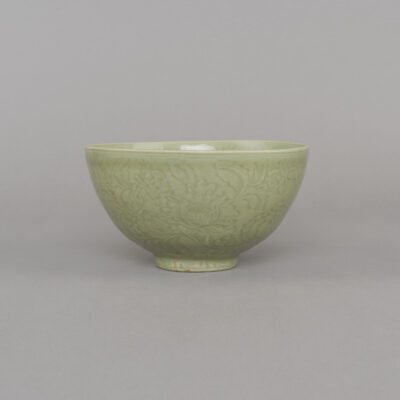
£68,000A superb Chinese celadon glazed thinly potted deep bowl, carved on the interior and exterior with the flowers of the four seasons, lotus, camellia, chrysanthemum and peony on a scrolling continuous leafy branch, the well of the interior with a single tree-peony issuing from rockwork amongst large leaves, the foot carved with a band of key-fret, covered overall in an even rich celadon glaze. Yongle/Xuande, Longquan kilns, Zhejiang Province, 1402-1435.
-
M4905
£23,500A superb Chinese celadon glazed tripod, two-handled incense burner with rounded body, cabriole legs, everted rim and upright openwork handles, covered overall in a bright celadon glaze extending to the interior and on the underside, the feet unglazed revealing the burnt-red fired body, the well of the interior used in the kiln for firing a further piece, with Japanese metalwork gilt- lined cover.
-
M4957
£16,500Chinese large celadon glazed tripod incense burner modelled in high-relief with a wide central register containing the ‘Eight Trigrams’ between carved leaves and flowers and within relief ribs, all on three cabriole feet and beneath the flat rim, covered overall in a rich and even unctuous celadon glaze extending onto the interior and base, the unglazed centre of the base and interior revealing the burnt-red biscuit body.
-
M5397
£9,800A Chinese porcelain wucai cylindrical charcoal burner, hire, painted in a continuous scene, with a seated scholar holding a wine cup in his left hand, whilst resting his right hand on a book, beside wine jars and kang table with a ewer, the reverse with his attendant bringing him a goose, amongst bamboo, plantain, rockwork, fencing and foliage, the enamels painted in bright tones of turquoise, yellow, green and aubergine, heightened in iron-red, all beneath a band of double keyfrets in underglaze blue dispersed between flowering branches and precious objects, and beneath a brown-dressed rim, most of the interior unglaze, all on a short foot rim, the underside with a four character mark, tian xia tai ping, "peace and prosperity under heaven", within a double square.
-
M5405
£7,500Chinese celadon glazed openwork rectangular-form table screen on integral stand incised with scrolls and petal-shape front, carved with two dragons, one rising from the waves, the other descending from the clouds in a square frame surrounded by seven apertures, the flanged sides incised with scrolls, the reverse plain with two holders for incense, the top edge with chamfered corners, covered overall in an even, rich, celadon glaze, the underside revealing the burnt-red biscuit body from the firing.
-
M5408
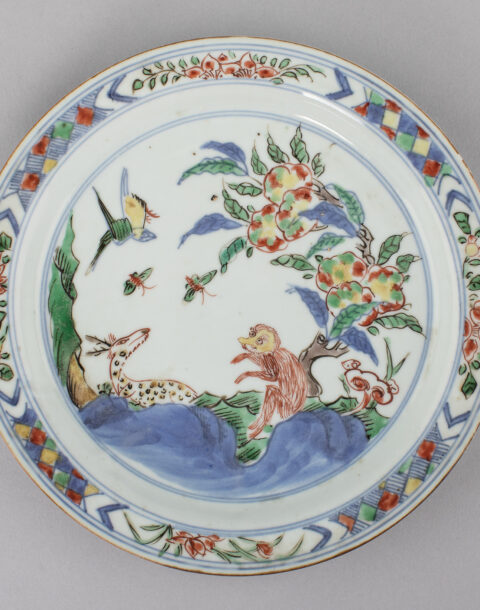
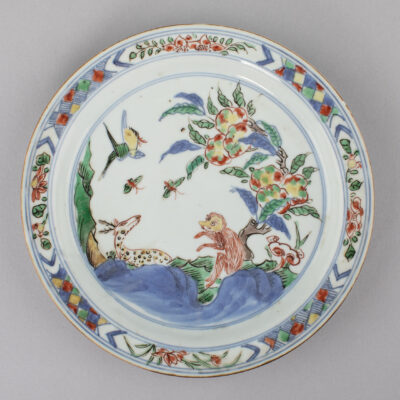
£6,850Chinese porcelain ko-akai, wucai, plate with flat, everted rim, painted with a large, iron-red monkey seated beneath a fruiting peach tree beside lingzhi fungus, watching a deer, swooping birds and insects amongst rockwork and within underglaze blue double lines, the border with four different flower sprays including prunus, lotus and daisy on a chequered ground, the rim predominantly covered in a pale brown wash.
-
M5417
£POAA remarkable massive Chinese celadon glazed vase carved in high relief on the body with peony flowers on scrolling branches with leaves, beneath a similar register on the neck, above a wide band of relief leaves above the ribbed foot, the flared curved rim with ribs, covered overall in a rich and even luminous celadon glaze continuing on the inside of the neck, the underside of the base with ink marks.
-
M5433
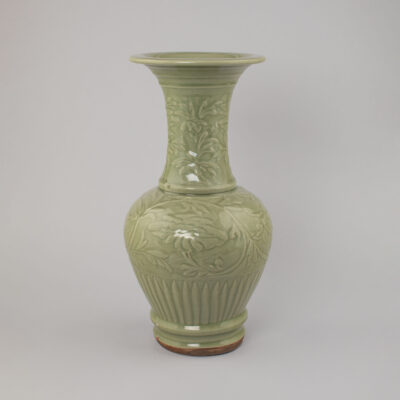
£72,000Large Chinese Longquan celadon-glazed vase of yenyen, feng wei zun, phoenix-tail, form, with tall, cylindrical flared neck, baluster body and raised foot, carved with large peony blooms on a continuous leafy branch, repeated on the neck, all on a slightly combed ground, between three classic ribs beneath the flared rim and with upright leaves above the foot, the footrim burned red in the firing with recessed glazed base, covered overall in a rich and even, luminous celadon glaze.
-
M5518
£8,500Chinese longquan celadon insense burner and cover of square form, moulded on the exterior in relief with four panels with the Eight Trigrams, repeated twice, within a relief frame, the flat cover surmounted by a Buddhist lion, holding a brocade ball and ribbon it its front paws.
-
M5540
£POAChinese porcelain wucai vase and cover of meiping form, painted in a continuous scene, from the Romance of the Western Chamber, with a monk at the monastery being visited by a bandit, with Ying Ying and her maidservant Hongnian looking out from beyond a screen, with a bearded figure looking out from a window, the underglaze blue particularly well-drawn with bamboo rockwork and the roof to the entrance of the monastery, the reverse with iron-red cloud banks, the drop over cover painted with lingzhi, aster and bamboo, the gently sloped top with fruiting peach in iron-red beneath the underglaze blue finial.
-
M5561
£16,500Large and substantially potted celadon glazed bowl, moulded on the exterior with a wide band of flowering lotus and camellia on scrolling, leafy branches above a band of stylised leaves and beneath a band of overlapping petals; carved on the interior with a single wide band extending to the base with the reverse technique of the exterior of lotus and camellia, all encircling a flowerhead in the well, the unglazed base burnt red in the firing with an impressed glazed centre.
-
M5630
£7,500Chinese porcelain wucai square-form dish with champfered corners painted in the centre with two phoenix birds in flight on an iron-red cash diaper ground, encircled by sprays of prunus, bamboo, pine and peach flower, the flat everted rim with iron-red keyfret.
-
M5779
£23,500Large Chinese porcelain blue and white serving dish with needle point foliate rim, hariki, brightly painted with large magpies and squirrels amongst the ‘three friends of winter’, sanyou, pine prunus and bamboo, the squirrels clambering amongst fruiting vine branches beneath a scrolling branch of flowers and a brown dressed foliate rim, the underside with birds perched on a continuous branch of flowering prunus.
-
M5798
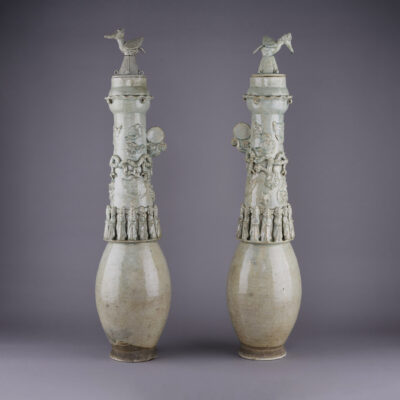
£12,500A large pair of Chinese high-fired ceramic ying qing, qingbai, storage vases and covers, each applied on the slender body with twelve standing figures and a further kneeling figure, beneath high-relief dragons writhing around the neck, with the moon, or a large circular pearl supported on a cloud spray, all amongst appliqués, including a further standing figure, deer, horse, qilin and cranes beneath a pie-crust relief band, the covers surmounted by cranes.
-
M5825
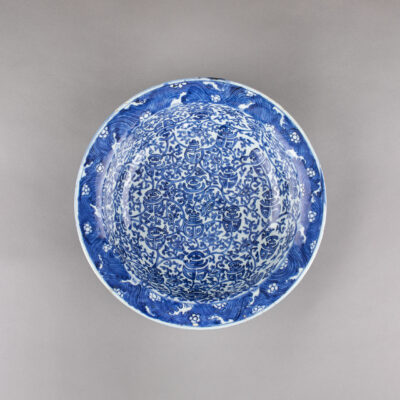
£9,500Chinese porcelain blue and white deep basin with flat, everted rim, painted in the centre and the cavetto with twenty-six large shou characters on a fruiting lingzhi continuous scrolling branch, beneath a blue ground wave border with plum blossom, the underside with branches and flowers beneath a blue-dressed rim.










Further information on Ming & Earlier
Early Ming dynasty ceramics took inspiration from the intricate but busy Islamic styles of the outgoing Yuan Mongols but it wasn’t long before the Han started to exert their own influences on design. From the 15th century onwards, Ming porcelain decoration became more subtle and restrained but as demand grew from Japan and Europe, it once again became more elaborate. It was one of China’s major exports and was often exchanged for Spanish silver. By the sixteenth century, Ming dynasty porcelain included vibrant colours such as blues, reds, greens and yellows.
By the late sixteenth and early seventeenth centuries, it was becoming increasingly common for producers of Ming pottery and Ming porcelain to add imperial reign dates to their wares and there started a trend for artists to sign their wares. A signature on a Ming vase of one of the most highly respected Ming dynasty porcelain artists could dramatically affect its price, such was the reputation of some of the artisan craftsmen of the era, not unlike the European painters of the day.
You should also check

Paintings
Chinese paintings, typically gouche and watercolour.

Underglaze Copper-Red
Pieces with the use of underglaze copper-red.
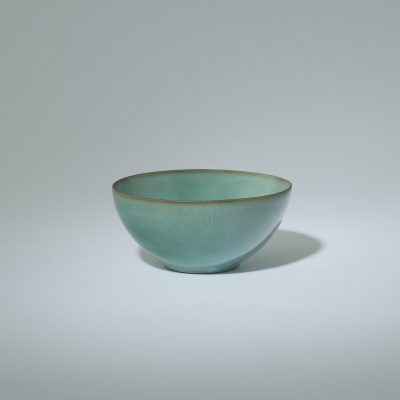
Kawase Shinobu - Master of Celadon, a retrospective
The exhibition features 52 pieces by the ‘Master of Celadon’, Kawase Shinobu. 20th June – 15th July 2022.
